For furniture brands, interior design firms, and bulk buyers, the choice of a
kitchen hutch factory determines product consistency, lead times, and long‑term reliability. A kitchen
hutch – a hybrid of open shelving, closed cabinetry, and often a serving counter
– demands precise joinery, stable wood conditioning, and a finish that resists
kitchen moisture and heat. Unlike simple bookcases, hutches undergo daily use:
heavy dinnerware, spilled liquids, steam from cooking. This article provides a
component‑level analysis of what to assess when sourcing from a kitchen hutch factory, covering wood drying kilns,
CNC machining, assembly methods (dovetail, mortise‑and‑tenon, dowel), sanding
sequences, coating lines (conversion varnish, UV curing), and packaging for
export. Drawing on data from Essent Home's ISO‑9001
certified facility, we will examine how to vet factories for scalability,
compliance (CARB2, Lacey Act), and defect rates – while avoiding common pitfalls
like veneer delamination, drawer migration, and finish yellowing.
1. Why the Kitchen Hutch Factory’s Production Process Matters for B2B
Buyers
For volume buyers, the technical capability of a kitchen hutch
factory directly impacts return rates, assembly time, and brand
reputation. Key performance indicators include:
Consistent joinery strength – prevents claims of drawer
separation or door sag after six months.
Moisture‑resistant finishing – avoids peeling or blistering
near sink areas.
Scalable lead times – ability to ramp from 100 to 1,000
units per month without quality drop.
Regulatory compliance – CARB Phase 2 for composite panels,
Lacey Act declaration for wood species.
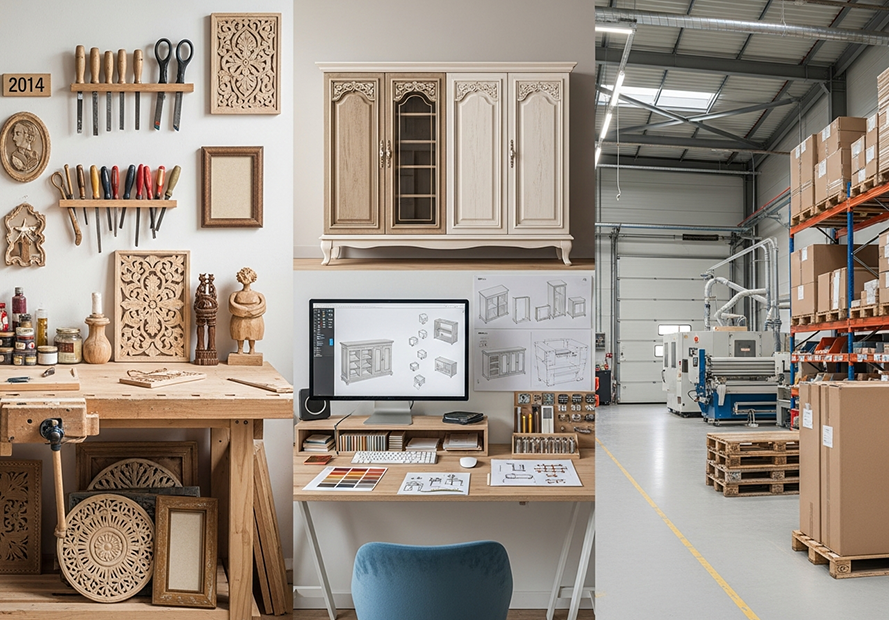
A professional kitchen hutch factory like
Essent Home operates a closed‑loop system: from
lumber kiln to CNC routing to spray booth, with in‑house quality labs. Their
defect rate of <0.8% (vs. industry average 3‑5%) comes from strict process
controls, which we detail below.
2. Raw Material Processing: Kiln Drying and Moisture Management
The first differentiator among kitchen hutch factory operations is how they treat incoming lumber. Unstable wood leads to warping,
cracking, or joint failure after the hutch reaches a climate‑controlled
home.
Kiln drying schedule: Hardwoods (oak, maple, cherry)
require a stepped temperature/humidity cycle over 14‑21 days to reach 6‑8%
moisture content. A factory without on‑site kilns often buys pre‑dried lumber of
unknown history – risky.
Acclimatization: After machining, components should be
stored in a climate‑controlled area (22°C, 45% RH) for 48‑72 hours before
assembly to relieve residual stresses.
Moisture meter checks: Every batch of incoming lumber and
finished components should be tested with a pin‑type meter; variance within a
batch must be < ±1%.
Essent Home operates a 120,000‑board‑foot vacuum kiln, reducing drying time
to 10 days while preserving wood color. Their kitchen hutch factory maintains a dedicated
conditioning chamber for machined parts – a sign of serious engineering.
3. Joinery and Assembly Technology: From CNC to Hand‑Fitted Joints
A high‑output kitchen hutch factory balances automated
precision with skilled assembly. Key equipment and methods:
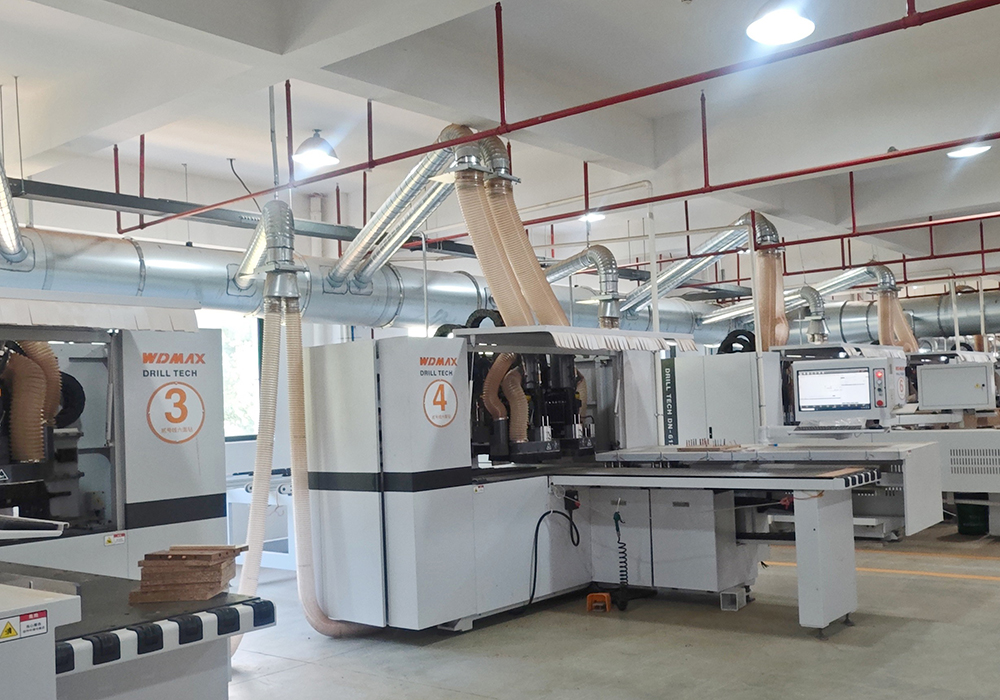
CNC routers (5‑axis): Used for cutting mortises, tenons,
and dovetail drawer blanks. Tolerances of ±0.2 mm ensure that components fit
without forcing.
Dovetail machine (automatic): For drawer boxes – through or
half‑blind dovetails are cut at 20‑30 pieces per hour. Inspect for glue
squeeze‑out and clean corners.
Case clamping stations: Pneumatic or hydraulic clamps apply
even pressure while PVA glue cures (minimum 30 minutes). Avoid factories that
use only pocket screws or staples.
Sandling lines: Wide belt sanders (6‑head) for panels,
followed by orbital sanders (180‑220‑320 grit progression) for final surfaces.
Cross‑grain scratches must be eliminated.
Essent Home’s kitchen hutch factory uses a Homag CNC
machining center and a Weinig moulder for profile wrapping. Each hutch receives
a 16‑point assembly checklist before moving to finishing.
4. Finish Application Systems: Conversion Varnish vs. UV Coatings
The finish on a kitchen hutch must resist alcohol, water, grease, and UV
light. A competent kitchen hutch factory will offer one of
these industrial‑grade systems:
Conversion varnish (catalyzed): Two‑part (resin + catalyst)
sprayed in a downdraft booth. Requires 24‑48 hours curing. Extremely durable,
resists yellowing, repairable. Industry standard for kitchen cabinetry.
UV‑cured coating: Applied by roller or spray and cured
instantly under UV lamps. Very hard, zero VOC, but difficult to touch up. Best
for flat panels.
Polyurethane (pre‑catalyzed): Lower durability than
conversion varnish but acceptable for budget lines. May yellow over
time.
Critical parameters: film thickness (target 100‑120 µm), adhesion cross‑cut
test (ASTM D3359), and resistance to 10% ammonia (household cleaner). Essent
Home’s finishing line includes a
climate‑controlled spray booth (23°C, 55% RH) and a conveyor oven for
accelerated curing, achieving a 5‑year warranty against finish defects.
5. Hardware Integration and Drawer Slide Testing
Soft‑close slides and hinges are the most common failure points. When
auditing a kitchen hutch factory, verify:
Supplier brands: Blum, Grass, Hettich, or equivalent Tier‑1
hardware. Avoid unbranded slides – they often lack cycle testing.
Cycle testing: Drawer slides should be tested to 50,000
cycles (ANSI/BHMA A156.9). Request test reports.
Installation method: Factory should use screw‑on or clip‑on
systems with precise jig drilling. Misaligned slides cause sticky drawers.
Door hinges: Six‑way adjustable, soft‑closing, with nickel
plating to resist corrosion. Hinge hole boring depth and spacing must be
consistent.
Essent Home’s kitchen hutch factory uses Blumotion hinges
and Tandem slides exclusively, with a dedicated hardware insertion line that
torque‑tests each screw.
6. Quality Control and Defect Prevention
Repetitive, preventable defects plague many factories. A disciplined
kitchen hutch factory implements in‑process inspections (IPI)
at six stages:
Lumber grading: Reject knots > 6 mm, checks, or
wane.
CNC machining: Check tenon thickness, mortise depth every
50 parts.
Dry assembly: Verify squareness (diagonal tolerance ±1 mm),
no gaps >0.3 mm.
Sandling: Inspect for swirl marks under raking light.
Finish application: Measure dry film thickness
(non‑destructive gauge) and test adhesion on a sample panel daily.
Final pack: Check for hardware completeness, protective
edge foam, and carton labeling.
Essent Home maintains a defect database with Pareto analysis – the top three
issues (usually hardware misalignment or finish runs) are addressed with
corrective action reports (CAR). Their kitchen hutch factory achieves a first‑pass yield of
96.5%.
7. Scalability and Lead Time Management
For B2B buyers, the factory’s ability to scale production without sacrificing
quality is crucial. Key metrics to request:
Monthly capacity (units): Based on 8‑hour shifts, two
shifts. Ask for a capacity plan.
Standard lead time: For custom (OEM) hutches – typically
8‑12 weeks; for stock designs – 4‑6 weeks.
Peak season buffer: Can the factory add a third shift or
outsource sub‑components? Verify that they have backup CNC routers and spray
booths.
Raw material inventory: A well‑run kitchen hutch
factory keeps 4‑6 weeks of kiln‑dried lumber and hardware stock to
avoid supply interruptions.
Essent Home operates on a lean manufacturing model with a 60‑day rolling
forecast. They have increased output by 40% in three months for a major retail
client without defect rate increase – a testament to process
standardization.
8. Compliance and Sustainability Certifications
Export‑oriented buyers must verify that the kitchen hutch
factory meets destination market regulations:
CARB Phase 2 / TSCA Title VI: For composite wood panels
(plywood, MDF) used in hutches – formaldehyde emissions ≤0.05 ppm.
Lacey Act declaration: For imported wood species – proof of
legal harvest and chain of custody.
FSC‑COC (Forest Stewardship Council): Required for green
building projects (LEED).
ISO 9001:2015: Quality management system.
Low VOC finishes: Compliance with SCAQMD Rule 1136 or
similar.
Essent Home maintains all above certifications and provides a compliance
package with every container shipment, including test reports from an accredited
third‑party lab (e.g., SGS or TÜV).
9. Industry Pain Points and Engineering Solutions
Even established factories face recurring issues. Below are three common
problems and how a professional kitchen hutch factory addresses
them.
Drawer migration (creep) over time: Drawers slowly slide
open due to floor slope or vibration. Solution – install detent catches or
soft‑close mechanisms that hold closed under 5 N of force. Essent Home uses
Blum’s Tandem with integrated hold‑close.
Panel delamination (veneer peeling): Caused by insufficient
adhesive spread or outdated press cycles. Remedy – use a roller coater for glue
(200 g/m²) and a cold press with 8‑bar pressure for 4 hours. Test weekly for
peel strength (>1.5 N/mm).
Finish orange peel (textured surface): Spray gun pressure
too high or thinner evaporation too fast. Solution – maintain viscosity (Ford
cup #4, 18‑20 s) and use a low‑pressure HVLP gun with proper overlap. Essent
Home’s finishing line includes automated viscosity control.
Data from Essent Home’s warranty returns show that these solutions reduced
finish‑related claims by 65% over three years.
10. Frequently Asked Questions (FAQ) – Kitchen Hutch Factory
Q1: How do I verify a kitchen hutch factory’s joinery quality without
visiting?
A1: Request a pre‑production sample (one
assembled hutch) and a video of the factory’s dovetail machine and case clamp
station. Also ask for a joint strength test report (ASTM D905 – shear strength
of adhesive bonds). Essent Home provides a virtual tour and sample shipment for
serious buyers.
Q2: What is the minimum order quantity (MOQ) for custom kitchen
hutches from a factory?
A2: MOQ varies: for full
custom (unique size, wood, finish) – usually 50‑100 units. For semi‑custom
(standard sizes, choice of finish) – 20‑50 units. Some factories like Essent
Home offer a “small batch” program for 10 units at a higher per‑unit cost.
Always negotiate MOQ based on your sales forecast.
Q3: How long should a conversion varnish finish cure before packing
and shipping?
A3: Minimum 72 hours at 22°C and 50%
RH. If packed earlier, the finish may still outgas, causing fogging on glass
doors or sticking to foam padding. Essent Home uses a forced‑air curing oven
(40°C for 24 hours) then waits another 24 hours before final pack – ensures zero
off‑gassing.
Q4: Can a kitchen hutch factory produce hutches with solid wood doors
and plywood carcases?
A4: Yes – this is a common
hybrid to balance cost and stability. The carcase (sides, top, bottom) uses
A‑grade birch plywood (9‑ply, 18 mm) with veneer matching the solid wood. The
factory must seal all plywood edges with edge banding to prevent formaldehyde
emission and moisture ingress. Essent Home offers this hybrid as a standard
option.
Q5: What documentation should I request for a container
shipment?
A5: Packing list, bill of lading,
commercial invoice, certificate of origin (if applicable), fumigation
certificate (for wooden pallets), and a quality control report with photos of
the final random inspection. For US imports, also a Lacey Act declaration and
TSCA Title VI certification. Essent Home provides a digital compliance binder
for every order.
Q6: How does a factory handle after‑sales defects or missing
parts?
A6: A professional kitchen hutch
factory maintains a spare parts inventory (hinges, slides, shelf pins,
touch‑up markers) for at least 5 years. For major defects, they should offer a
replacement or credit based on a claim with photos. Essent Home’s warranty
covers 10% parts buffer with every shipment and a 48‑hour response to
claims.
11. Partner with a Verified Kitchen Hutch Factory for Consistent
Quality
Selecting the right kitchen hutch factory requires more than a price
quote – it demands a technical audit of their wood processing, joinery
equipment, finishing line, and quality system. Generic furniture workshops often
lack the controlled environment and process discipline needed for kitchen‑grade
durability. Essent Home operates a
modern facility with in‑house kilns, CNC machining, and a climate‑controlled
spray booth – all certified to ISO 9001 and CARB2.
Essent Home offers B2B buyers:
Free factory audit and capability presentation (virtual or on‑site).
Custom OEM/ODM from your CAD drawings or their design library.
Small batch program (10 units) for market testing.
Container consolidation and door‑to‑door logistics management.
Request a factory qualification package today – send your
target order volume, preferred wood species, and desired finish type. Our
production engineers will respond within 3 business days with a capability
statement, sample pricing, and lead time projection. Click here to contact Essent
Home’s B2B sales team or call +86 0591-22068125. We also provide free sample
hutches for qualified buyers (shipping only).